
How to Say Thank You in Maya and Spanish This Thanksgiving
Gratitude has always been an essential part of life in the Yucatán Peninsula. Long before modern holidays, the Maya expressed thanks through ceremonies honoring the Earth, the harvest, the sea, and the balance that sustains everyday life.
Today in Akumal, a place shaped by Maya heritage, Mexican tradition, and an international community, gratitude is spoken in three languages: Maya, Spanish, and English. Learning how people here say thank you is more than a phrase lesson — it is a doorway into a culture built on respect, reciprocity, and appreciation.
How to Say Thank You in Maya
The most widely spoken Indigenous language in the region is Yucatec Maya.
The phrase for thank you is:
Yuum bootik
Pronounced: youm boh-oh-teek
This phrase goes deeper than a casual thank-you.
- Yuum refers to a giver, benefactor, or divine provider.
- Bootik carries the meaning of gratitude or giving thanks in return.
Together they express appreciation as an exchange, not just a response — reflecting the Maya belief that harmony depends on giving back what you receive.
Variations You May Hear in Akumal
Because Akumal is trilingual, locals often switch comfortably between languages. Alongside Yuum bootik, you may hear:
- Yuum bootik tech — thank you (to one person)
- Yuum bootik teex — thank you (to a group)
- Dios bootik — a hybrid Spanish-Maya expression sometimes used in conversation (not a traditional Maya construction, but familiar enough to hear locally in Akumal).
These variations show how language evolves in living communities.
How to Say Thank You in Spanish
Spanish is spoken throughout the region alongside Maya. The most common expressions are:
Gracias
A universal, warm thank-you.
You may also hear:
- Muchas gracias — an emphatic thank you
- Gracias de corazon — thank you from the heart
In Akumal, Spanish and English blend naturally with Maya, especially in restaurants, beach clubs, shops, and local families who have grown up speaking all three.
What a Maya Ceremony of Thanks Represents
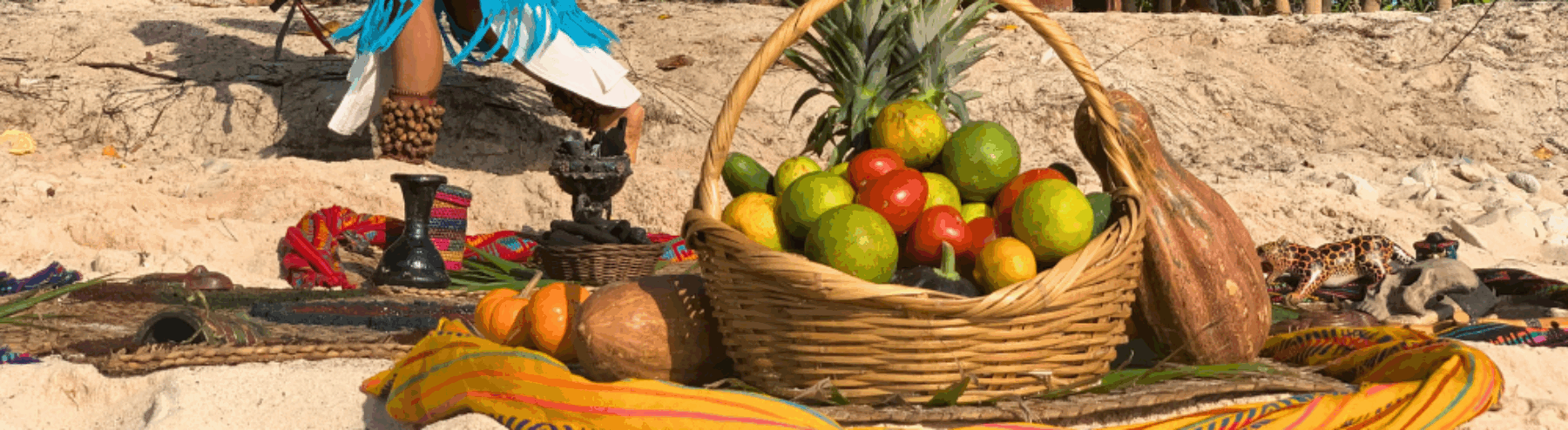
The image above reflects elements often seen in Maya gratitude ceremonies — rituals rooted in honoring nature, asking for guidance, and giving thanks for abundance.
Although these ceremonies differ across communities, several meaningful symbols are shared:
1. Food Offerings
A basket of fruit, maize, seeds, or gourds represents the gifts of the Earth.
Traditional offerings may include:
- Maize, considered the origin of human life in Maya creation stories
- Fruits and vegetables, representing the seasonal harvest
- Cacao and seeds, symbols of prosperity and community
Laying them on a woven mat or colorful textile honors the Earth as both provider and receiver.
2. The Conch Shell (Caracol)
The conch shell’s deep, powerful sound is used to:
- Announce the beginning of the ritual
- Call in the four cardinal directions
- Invite ancestors and protective spirits
- Mark transitions within the ceremony
Its voice is believed to connect the physical and spiritual worlds.
3. Shell and Seed Rattles
Ankle rattles, seed noisemakers, and natural percussive instruments accompany the ceremony:
- Sound purifies the space
- Rhythm grounds participants in the moment
- Movement awakens intention and gratitude
These rhythmic elements mirror the heartbeat of the Earth — reminding participants that gratitude is something you feel as much as you say.
Gratitude in Three Languages
Akumal is a community where languages overlap as naturally as the waves on the shoreline. Whether spoken at a ceremony, shared at the table, or offered as a warm gesture during a visit, gratitude here flows through three expressions:
Yuum bootik.
Gracias.
Thank you.
Different languages, same intention — appreciation for what we receive, for what we share, and for the people and places that shape our lives.
If you find yourself in Akumal this season, try offering a simple Yuum bootik. You may be surprised by the smile it brings.
For more about connecting with local language experts or planning your visit to Akumal, contact us at hola@akumalmx.com.